Profit Behavior Studies
Understanding How Contractor Margins Develop in Residential Service Markets
Contractor profit outcomes rarely emerge from pricing conditions alone. Margins develop within a broader system shaped by homeowner decision behavior, contractor positioning, and the environments where comparisons occur.
Discussions of contractor profitability are often framed in simple financial terms. Labor costs increase. Material prices fluctuate. Competitive pressure intensifies. Margins appear to respond accordingly.
Closer examination suggests a more complex process.
Profit Behavior Studies examine these structural relationships. The purpose of this research is to understand how contractor profitability develops under real market conditions. Observed patterns provide insight into how margins expand, stabilize, or compress across different contractor industries.
Within this research framework, profit behavior refers to the observable patterns that influence how contractor margins change over time. Financial outcomes are rarely random. Instead, they tend to follow structural conditions present within contractor markets.
Certain contractors consistently maintain stronger margins. Others operate under persistent pricing pressure. Differences in technical skill alone do not fully explain this variation. Market structure and decision environments frequently play a larger role.
Homeowner comparison systems influence how contractor value is interpreted. Trust signals shape credibility before estimates are reviewed. Service category economics further influence how homeowners evaluate risk. Profit behavior studies analyze how these factors interact to produce different margin outcomes.
Structural Conditions & Margin Outcomes
Examining the forces that influence profitability across residential service markets.
Conditions Associated with Margin Expansion
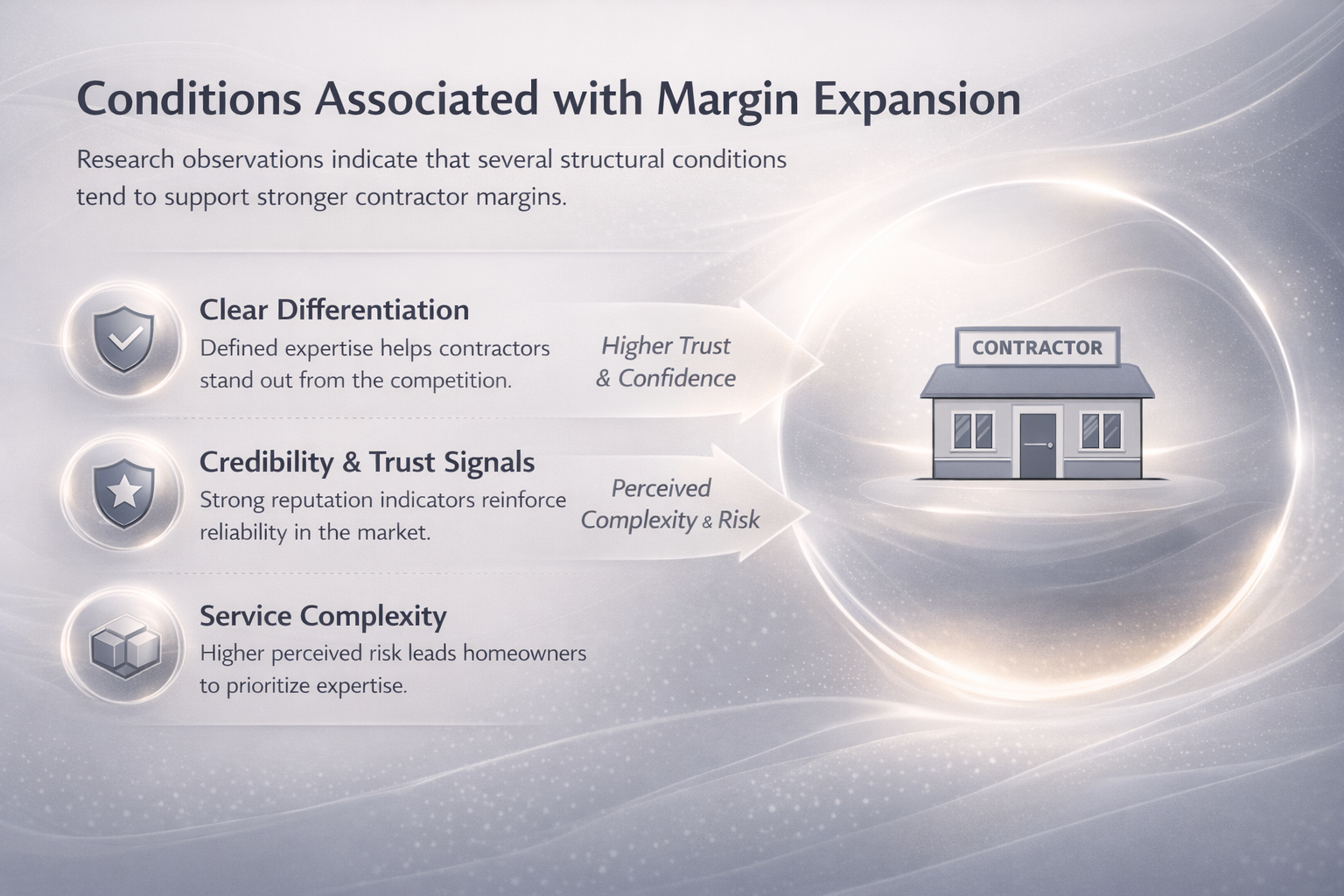
Research observations indicate that several structural conditions tend to support stronger contractor margins. Clear contractor positioning is often one such condition. When contractors communicate a defined area of expertise, homeowners are able to interpret their value more easily. Specialization reduces uncertainty during comparison.
Distinct identity also affects how contractors appear within decision environments. A clearly differentiated contractor is less likely to be evaluated as interchangeable with other providers.
Trust signals contribute to this process. Consistent reputation indicators reinforce credibility, and professional presentation strengthens perceptions of reliability. When multiple signals align, homeowners often feel greater confidence.
Service category structure can further influence margin expansion. In environments involving higher perceived risk or technical complexity, homeowners frequently prioritize reliability and expertise over price alone.
Conditions Associated with Margin Compression
Other structural conditions are associated with persistent margin pressure. Comparison environments frequently produce this effect when contractors appear highly similar to one another.
When differentiation is limited, price often becomes the primary evaluation signal. Unclear positioning contributes to this dynamic. Contractors who present broadly defined services may be more difficult for homeowners to evaluate confidently.
Uncertainty encourages reliance on simple comparison metrics. Price becomes the most visible metric available. Service category characteristics can reinforce these patterns. Routine household repairs may be perceived as tasks that many contractors can perform, thus increasing competitive pressure.
Variation Across Service Categories
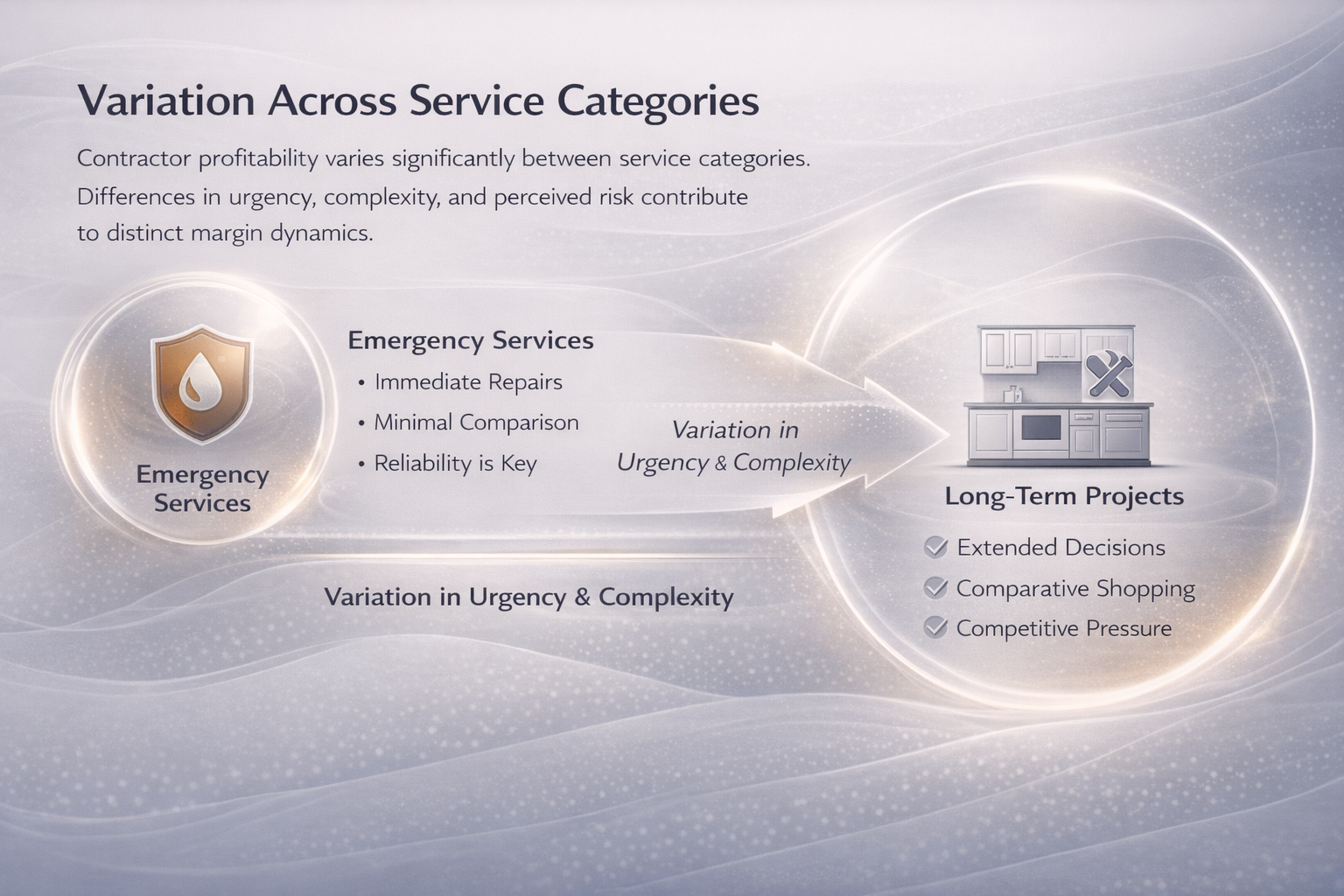
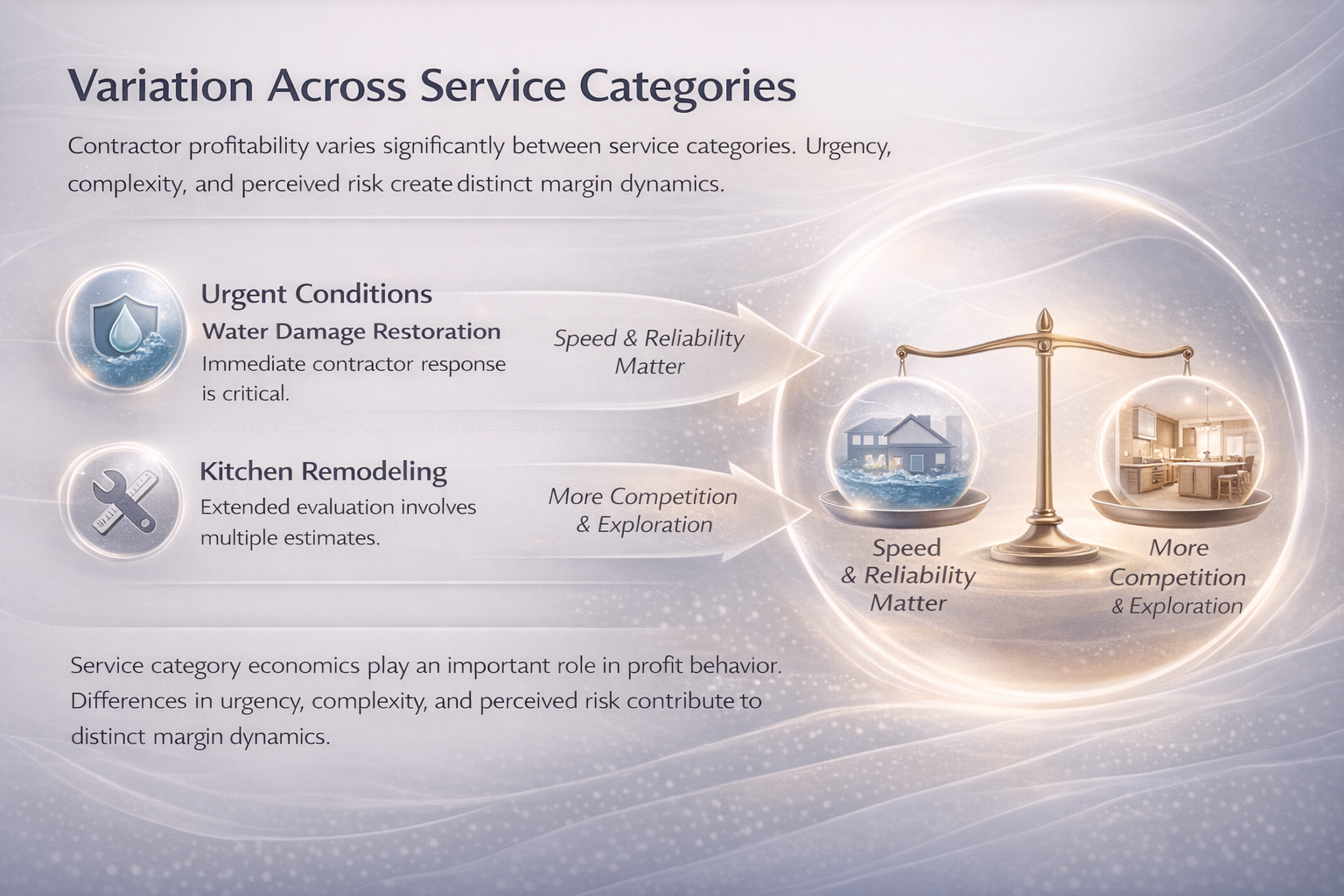
Contractor profitability varies significantly between service categories. Certain industries involve urgent homeowner problems. Water damage restoration provides a common example. Immediate response becomes critical, and the reliability of the contractor may carry greater weight than price.
Other services allow longer decision timelines. Kitchen remodeling projects may involve extended evaluation periods. Time influences comparison behavior, often exposing homeowners to additional signals, competing estimates, and alternative interpretations of value.
Service category economics therefore play an important role in profit behavior. Differences in urgency, complexity, and perceived risk contribute to distinct margin dynamics.
The Role of Contractor Positioning
Contractor positioning influences how homeowners interpret available information. A contractor associated with a clearly defined expertise is often easier for homeowners to evaluate. Specialization signals focus and experience.
In contrast, broad positioning may create ambiguity. When the contractor's identity is unclear, homeowners may struggle to distinguish meaningful differences between competing providers.
Under those circumstances, comparison frequently shifts toward price. Profit behavior studies examine how contractor positioning affects margin outcomes within different decision environments.
Trust Signals and Margin Outcomes
Trust signals play a central role in contractor evaluation because direct assessment of technical ability is rarely possible before a contractor is hired.
Homeowners therefore rely on signals that suggest credibility. Online reviews provide evidence of prior customer experiences. Professional presentation indicates organizational competence. Familiar local presence may also strengthen perceived reliability.
Signals rarely operate independently. Clusters of consistent signals tend to reinforce one another. Inconsistent signals may increase uncertainty. Researchers examine how variations in signal strength influence profitability.
Market Structure and Regional Conditions
Contractor markets differ substantially across regions and service categories. Market density influences comparison behavior.
Higher density tends to intensify competition within decision environments. Lower density may allow stronger contractor positioning.
Local housing characteristics also shape demand patterns. Property age, household income levels, and regional construction styles influence the types of services homeowners require. Profit behavior studies evaluate how these structural conditions interact with homeowner decision systems.
Why Profit Behavior Research Matters
Variation in contractor profitability often appears difficult to explain. Two contractors may operate in similar geographic markets. Work quality may be comparable. Profit outcomes may still diverge significantly. Structural positioning frequently explains these differences.
Contractors operating within favorable decision environments may experience stronger margins. Others remain within comparison systems that emphasize price over expertise.
Profit behavior research seeks to clarify these patterns. A clearer understanding of margin dynamics benefits both contractors and homeowners.
Contractors gain insight into the structural forces shaping profitability. Homeowners benefit from decision environments that better reflect contractor value and reliability. Contractor Margin Research studies these patterns to improve understanding of how contractor markets function and how margin outcomes develop over time.