
Contractor Margin Research
A Research Division of Advanced AI Marketing
We study how homeowner behavior, trust signals, market positioning, and decision environments affect contractor margins.
Understanding the Systems That Shape Contractor Profitability
Contractor margins rarely collapse overnight. Gradual erosion is more common, and in many cases the cause remains unclear. Strong work may be delivered on a project. Crew performance can be excellent. Completion may be clean and professional. Yet, pressure can still appear on the next bid.
A lower competitor enters the comparison. Homeowners pause or reconsider. Industry discussions often point toward pricing competition. Other explanations include marketing tactics or local market conditions.
Those explanations describe only part of the situation.
Structural forces begin operating long before a homeowner contacts a contractor. Comparison environments shape perception. Trust signals influence interpretation. Early impressions guide the final decision.
Contractor Margin Research studies these structural forces. Focus remains on the systems that influence contractor profitability before the first conversation occurs. By the time a contractor receives a call, comparison has often already taken place.
Research Thesis
Margin performance is influenced by structural forces that operate before project work begins.
Homeowners rarely evaluate contractors with complete information. Meaning is assembled from fragments.
- A review on Google or Yelp.
- A recommendation from a neighbor.
- A familiar company name.
- A website that appears credible.
- A price that seems reasonable.
Fragments accumulate over time. Patterns begin to form. Within the research framework these patterns create what we refer to as a contractor decision environment.
Inside this environment, evaluation begins long before a formal estimate is delivered. Impressions develop during the search process. Credibility forms gradually. Risk is interpreted quickly. Some contractors appear interchangeable.
Margin outcomes frequently reflect how this environment interprets contractor value. Contractor Margin Research examines how these environments develop and how they influence contractor profitability.
The Contractor Margin Problem
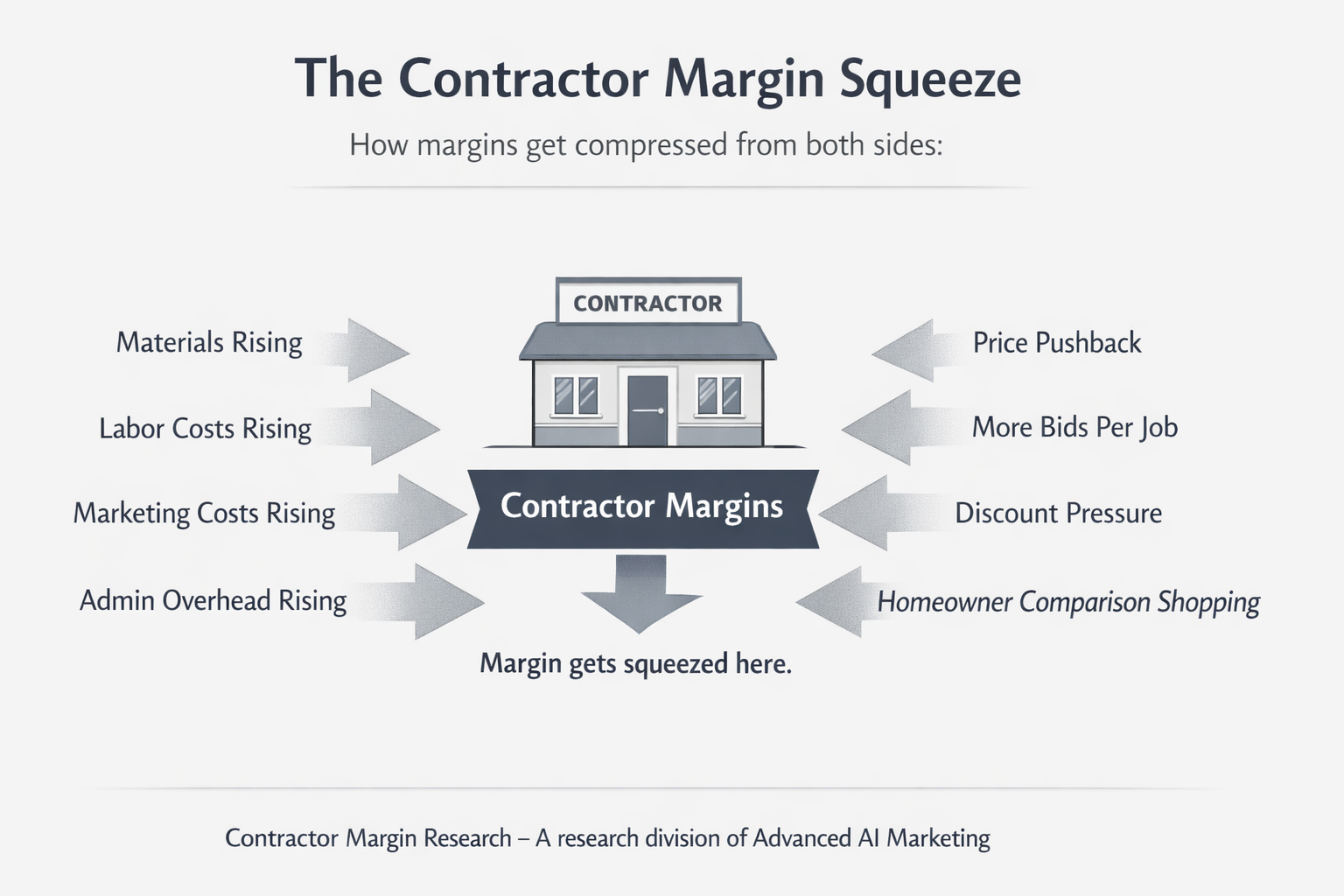
Price competition is often identified as the primary cause of margin pressure, but closer observation reveals a different sequence.
Visible competition reinforces the assumption of price pressure. However, misunderstanding homeowner decision systems often occurs first. Contractor selection rarely happens under calm conditions. Many decisions occur while the homeowner is standing inside the problem itself:
The Urgent Situation
A leaking ceiling, a cracked pipe, or storm damage to a roof. Urgency enters the situation.
Incomplete Information
Information remains incomplete. Evaluation must happen quickly.
Unstable Systems
During these moments comparison systems become unstable. Signals overlap. Reviews conflict. Differences between contractors become difficult to interpret.
Comparison Distortion
This condition produces what the research describes as comparison distortion. Under comparison distortion, contractors with very different experience levels may appear similar. Once perceived similarity forms, price becomes a dominant signal. Margin pressure follows.
Understanding this decision structure forms the central focus of Contractor Margin Research.
Core Analytical Variables
Contractor Margin Research evaluates profitability through five analytical variables. Interaction between variables is common. Rarely does a single factor determine contractor selection.
Homeowner Behavior
Patterns emerge when homeowners search for contractors. Options are gathered. Signals are scanned quickly. Perceived risk is reduced. Familiar choices are compared.
Observation of these patterns reveals how decisions unfold in practice.
Trust Signals
Technical ability is rarely evaluated directly at the beginning. Credibility is interpreted through signals.
- Online reviews
- Reputation indicators
- Professional presentation
- Local familiarity
Signal clusters often shape perception before technical capability is fully understood.
Decision Environments
Contractor comparisons occur within identifiable environments: Search results, directories, review platforms, and referral networks.
Structure within each environment organizes how contractors appear relative to one another. Subtle differences influence perceived reliability.
Market Positioning
Contractor identity affects interpretation. Specialists communicate focused expertise. General contractors signal flexibility.
Clear positioning reduces uncertainty. Ambiguous positioning increases comparison pressure.
Service Category Economics
Economic conditions vary between services. Some require urgent response, others allow extended evaluation. Certain categories involve high structural risk.
These distinctions influence behavior and margin structures, explaining why some services maintain stronger margins.
Research Domains
Work at Contractor Margin Research is organized across several research domains, exploring structural dimensions of contractor profitability.
Margin Pressure Studies
Examination of the conditions that generate sustained pricing pressure in contractor markets.
Homeowner Decision Behavior
Analysis of how homeowners evaluate contractors when information is incomplete and risk is present.
Trust Signal Analysis
Investigation of how credibility indicators influence homeowner interpretation of contractor reliability.
Decision Environment Research
Study of where contractor comparisons occur and how those environments shape perceived value.
Contractor Failure Pattern Studies
Documentation of recurring project failures that reveal structural weaknesses in contractor standards and accountability systems.
Service Category Economics
Comparative analysis of margin structures across contractor service categories.
Together these domains form the analytical foundation of Contractor Margin Research.
Research Methods
Research activity relies on structured observation and comparative analysis.
Multiple information sources contribute to each study. Each source offers a different perspective on contractor margin dynamics. Patterns become visible when these perspectives are analyzed together.
- Field case studies from contractor projects
- Observed homeowner decision behavior patterns
- Service category comparison analysis
- Market structure observation
- Failure pattern investigation
- Contractor outcome comparisons
Featured Research
Ongoing studies examine contractor profitability across multiple dimensions.
Profit Behavior Studies
Analyzing margin outcomes across contractor service categories.
Failure Pattern Studies
Documenting structural breakdowns in contractor accountability and project execution.
Decision Environment Analysis
Examining how contractor comparison systems shape homeowner decisions.
Service Category Margin Reports
Comparing structural differences between contractor industries.
These publications provide structured insight into how contractor margins develop within real market conditions.
Strategic Implications
Margin performance affects more than contractor profitability. Homeowner outcomes are influenced. Contractor standards are shaped. Market stability is affected.
When decision environments fail to communicate contractor value clearly, several consequences emerge. Reliable providers become difficult to distinguish. Unnecessary price pressure appears. Maintaining high standards becomes harder. Long-term effects weaken both contractor markets and homeowner trust.
Research clarifies these structural dynamics. Improved understanding supports stronger contractor positioning. Clearer trust signals increase homeowner confidence. Better decision environments align value with price.
Contractor Margin Research exists to study these systems and provide clarity on how contractor markets function. Improving the system begins with understanding it.